Article
AR-ENG-0004 / Public
The BOB Maniple: Orderly Units in Ward Service
Badly damaged engineering test documents and patient accounts suggest the BOB Orderly began as a tray-service machine before becoming part of a wider automated ward surveillance system.
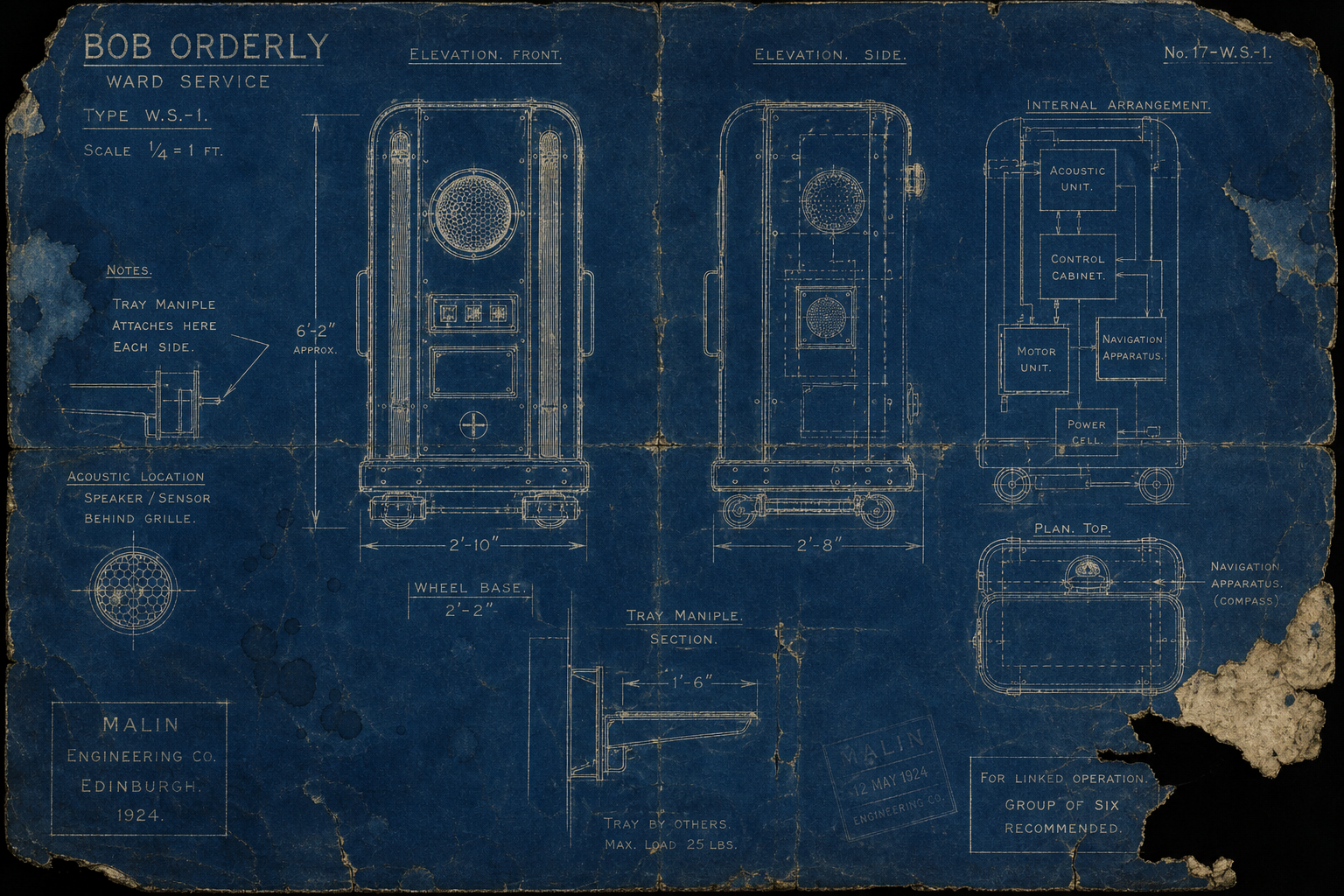
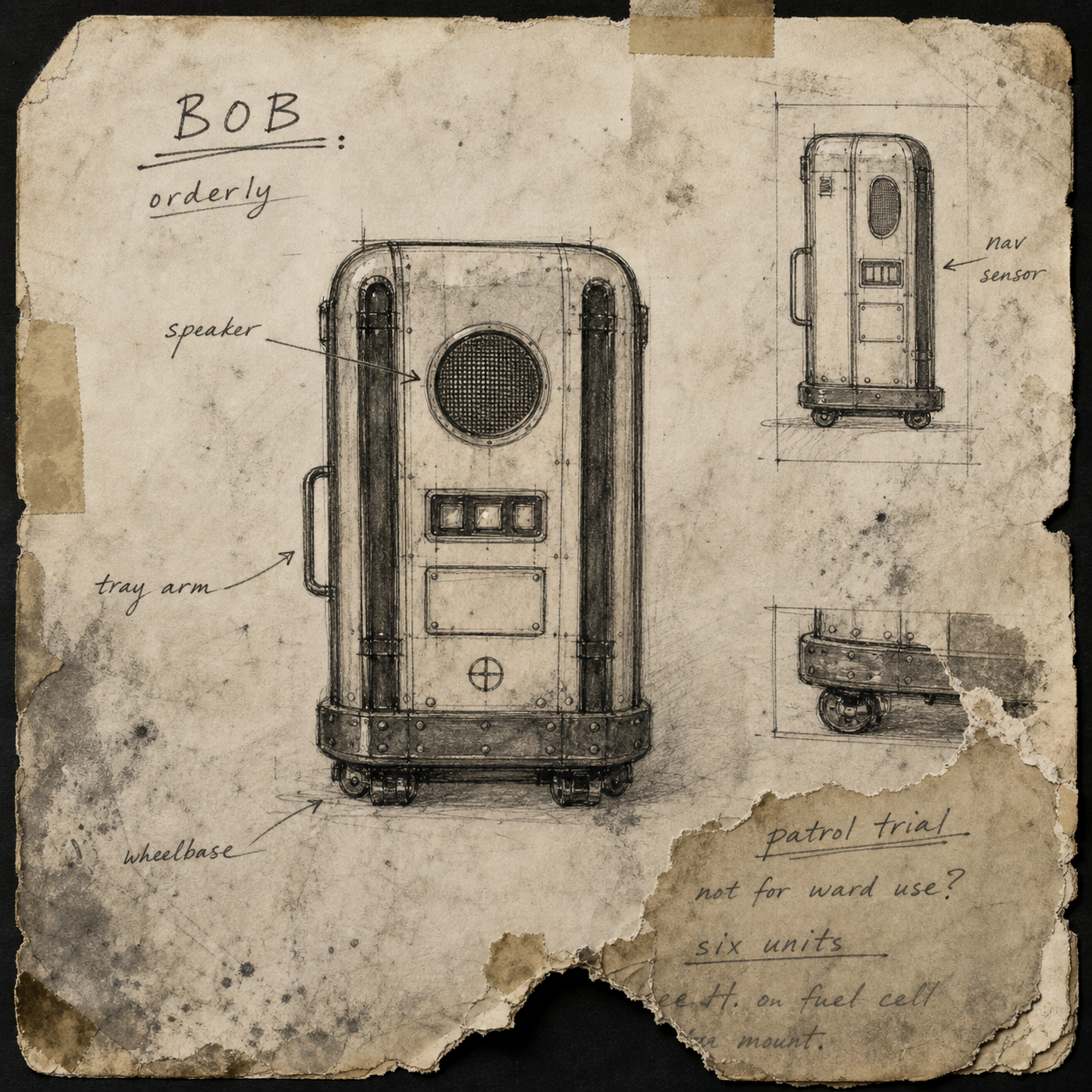
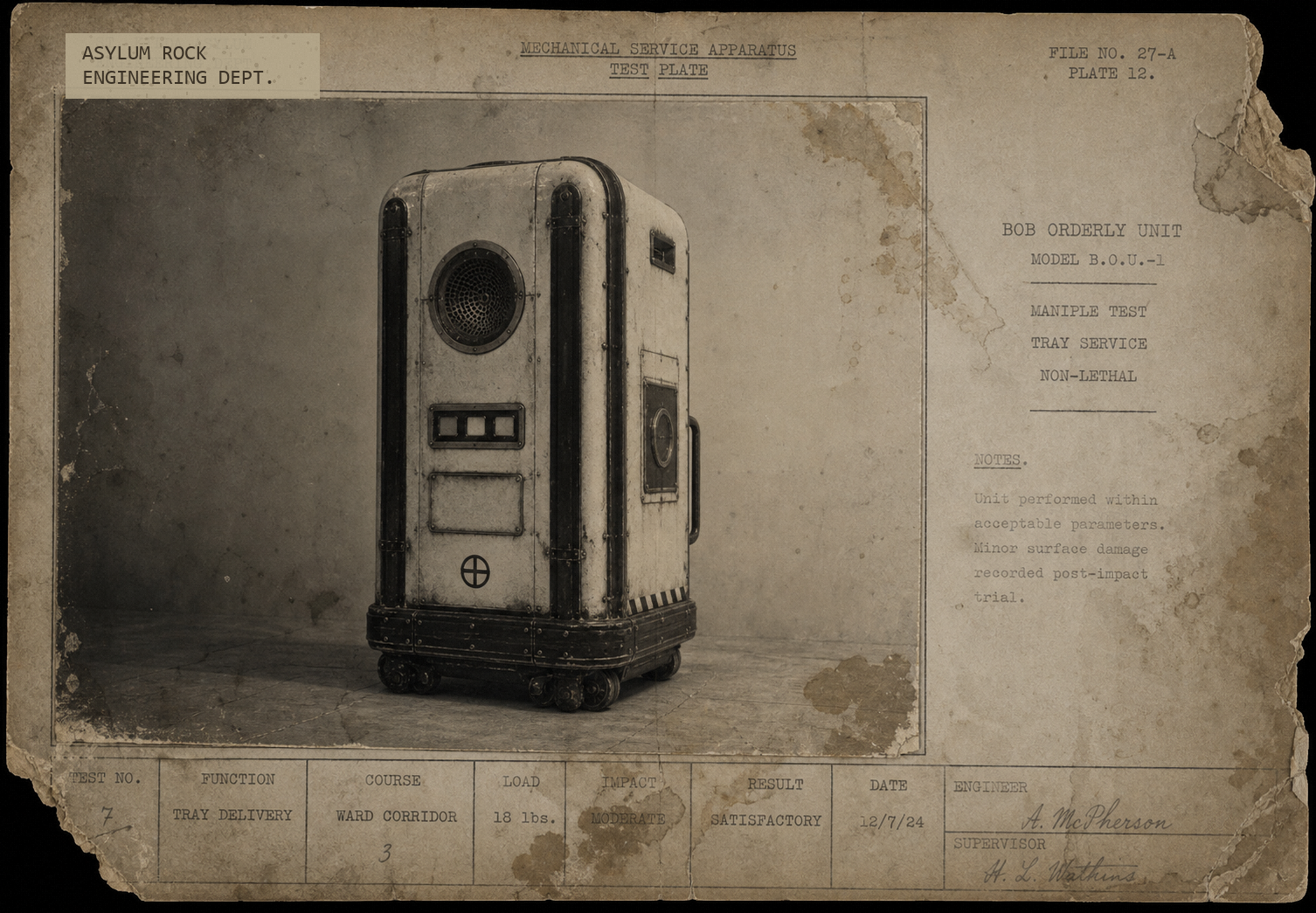
A small group of badly damaged engineering test documents has added detail to one of the hospital's more persistent mechanical rumours: the BOB Maniple system. The surviving material is incomplete, but it aligns closely with patient accounts describing large wheeled service cabinets introduced into the wards during the late 1920s and early 1930s.
The unit examined here appears to be the basic BOB Orderly. Early witness descriptions are practical rather than dramatic. Patients recalled a tall, bulky machine, often estimated at around 190 centimetres, moving between kitchens and wards with drinks, trays, and simple food-service attachments. The immediate purpose seems to have been labour substitution. Nurses were becoming harder to retain, and the hospital needed routine ward tasks removed from already strained medical staff.
The first units were reportedly cumbersome. They could deliver trays, stop at ward stations, and present a service attachment, but little more. Within a year, however, patient statements begin to change. Several mention a recorded voice able to address patients by instruction or warning. Others describe a unit pausing before turns, correcting its route without visible guidance, or finding its way back to a corridor after being obstructed.
The engineering fragments use the phrase acoustic location, though the exact mechanism remains unclear. Some notes suggest a directional echo system. Others have been interpreted as an early form of short-range radar or proximity detection. Whatever the mechanism, the later BOB Orderly was no longer limited to fixed routes. It could navigate freely enough to become useful beyond tray service.
By the early 1930s, BOB units were being described as roving patrol devices. Patient accounts place them near stairwells, service doors, hydrotherapy access corridors, and ward thresholds after lights-out. They were said to watch for patients in danger, intercept attempted escapes, and summon staff by signal. Whether the units were protective, custodial, or both appears to have depended on the ward and the period.
No surviving unit markings have confirmed individual identities. The machines were collectively referred to as BOB, and patients used the name as if it applied to any one of them. Even so, reports of more than one hundred active units are credible. Differences in scuffing, wheel noise, panel abrasion, grille damage, and side-handle wear appear in enough independent accounts to suggest a large operating population.
The system's success seems to have encouraged Malin to expand the platform. Human orderlies remained difficult to employ, especially for the lower wards and sealed service levels. Later references name additional variants: Spotters, Restrainers, and Gatherers. Malin documentation repeatedly describes these machines as non-lethal. That phrase does not settle the matter. Fragments recovered from less accessible records suggest that patient restraint was not without incident.
The perceived intelligence of the BOB units remains one of the more difficult claims to assess. Individual machines may have been simple. Test logs and visual reports, however, imply that a group of six could operate with a rudimentary shared behaviour: prioritising corridor movement, adjusting patrol spacing, and coordinating restraint or recovery actions. If accurate, this would make the BOB Maniple less a single machine than a small mechanical swarm.
Several questions remain open. The Trust has not confirmed whether BOB was an acronym or simply a name that became operational shorthand. The exact nature of the Restrainer and Spotter variants is still unclear. Most importantly, it is not yet known whether any BOB units remain inside locked wards beneath Asylum Rock.
That last question matters because of the so-called Malin Failsafes: automated systems believed to have kept portions of the hospital functioning into the period of Anne Shepherd's 1958 investigation. If the Failsafes continued to supply power, route instructions, or patrol signals, then the BOB units may not belong only to the archive. They may belong to the sealed wards.