Article
AR-ENG-0006 / Public
The Standing Custodian: A Complete Unit Recovered on Gondola Island
The first substantially complete Custodian unit has been recovered from a sealed storage crate beneath the Keeper's House on Gondola Island, raising new questions about Malin assembly work and the source that still holds the machine upright.
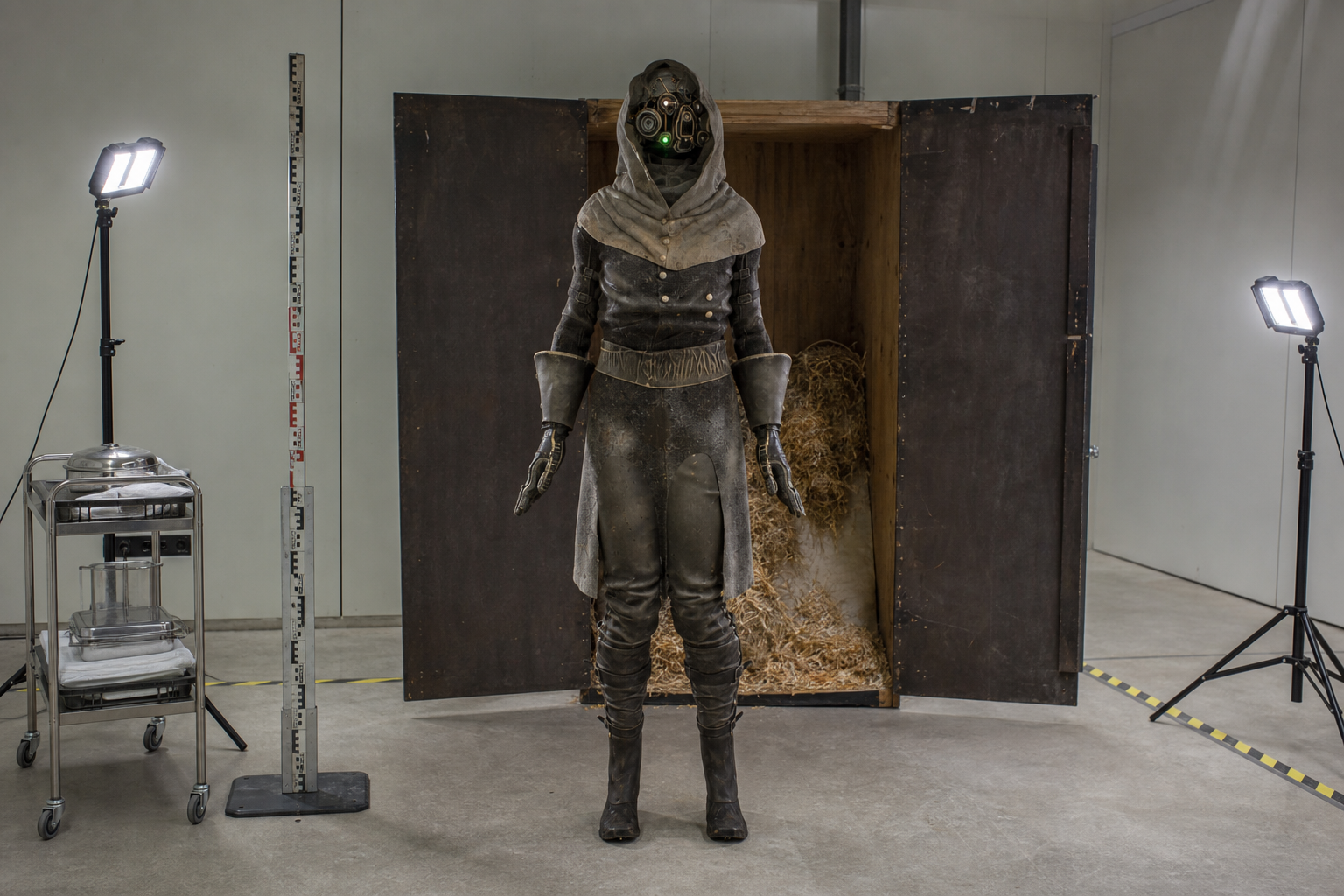
An inactive Custodian system has been recovered from a storage basement beneath the Keeper's House on Gondola Island. It is the first substantially complete example available for examination. Previous Custodian finds consisted of isolated actuators, damaged limb assemblies and several disputed pieces of joint hardware; none preserved the overall form of the machine, and none could be confidently reconstructed as a working body.
The Keeper's House basement had previously been catalogued as an administrative store. Its surviving shelves contained port paperwork, cargo manifests, customs notices and material relating to Gondola Island's former role as a controlled transfer point between the mainland, Asylum Rock and Pandora's Rock. The room in which the crate was found lay behind later shelving and a boarded partition. Nothing on the accessible paperwork identified the contents, although faded handling marks suggest the crate was treated as machinery rather than furniture or personal effects.
That location has altered the Institute's understanding of Gondola Island. The island was not merely a port and transit station. Several adjoining basement rooms contain floor fixings, narrow-gauge handling marks, redundant cable routes and benches too heavily constructed for ordinary clerical work. Taken together, these features raise the possibility that one of Troy Malin's component preparation or final-assembly facilities occupied the lower levels beneath the house.
No single piece of evidence yet proves the existence of a complete factory. The cleared rooms could have served as a repair depot, bonded engineering store or staging area for machinery destined for Asylum Rock. Even so, the mixture of fixtures is difficult to reconcile with paperwork storage alone. Custodian limb parts, Nursing-unit fittings and BOB subassemblies may have been manufactured elsewhere, brought through the port under ordinary cargo descriptions and prepared here before movement across the island chain.
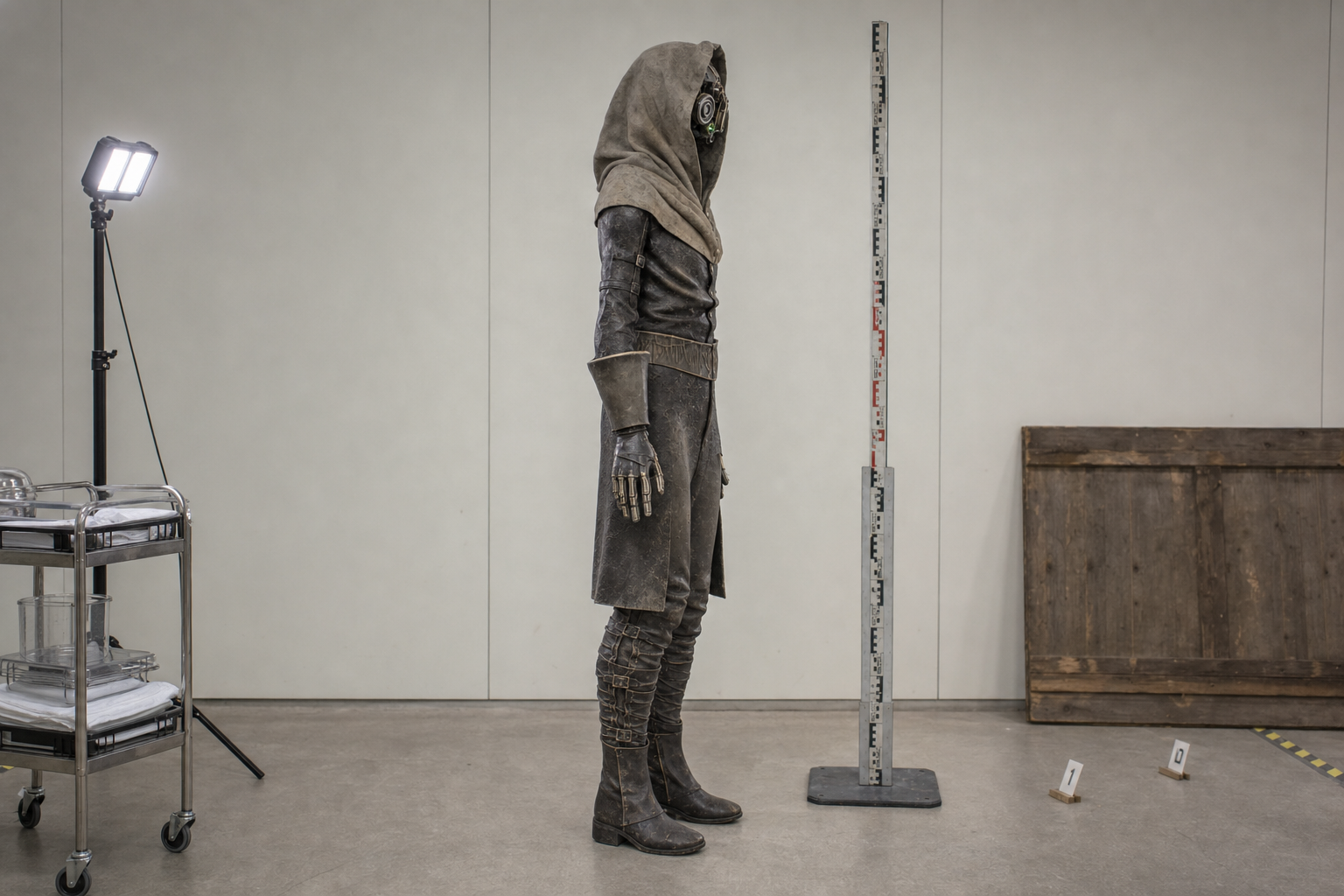
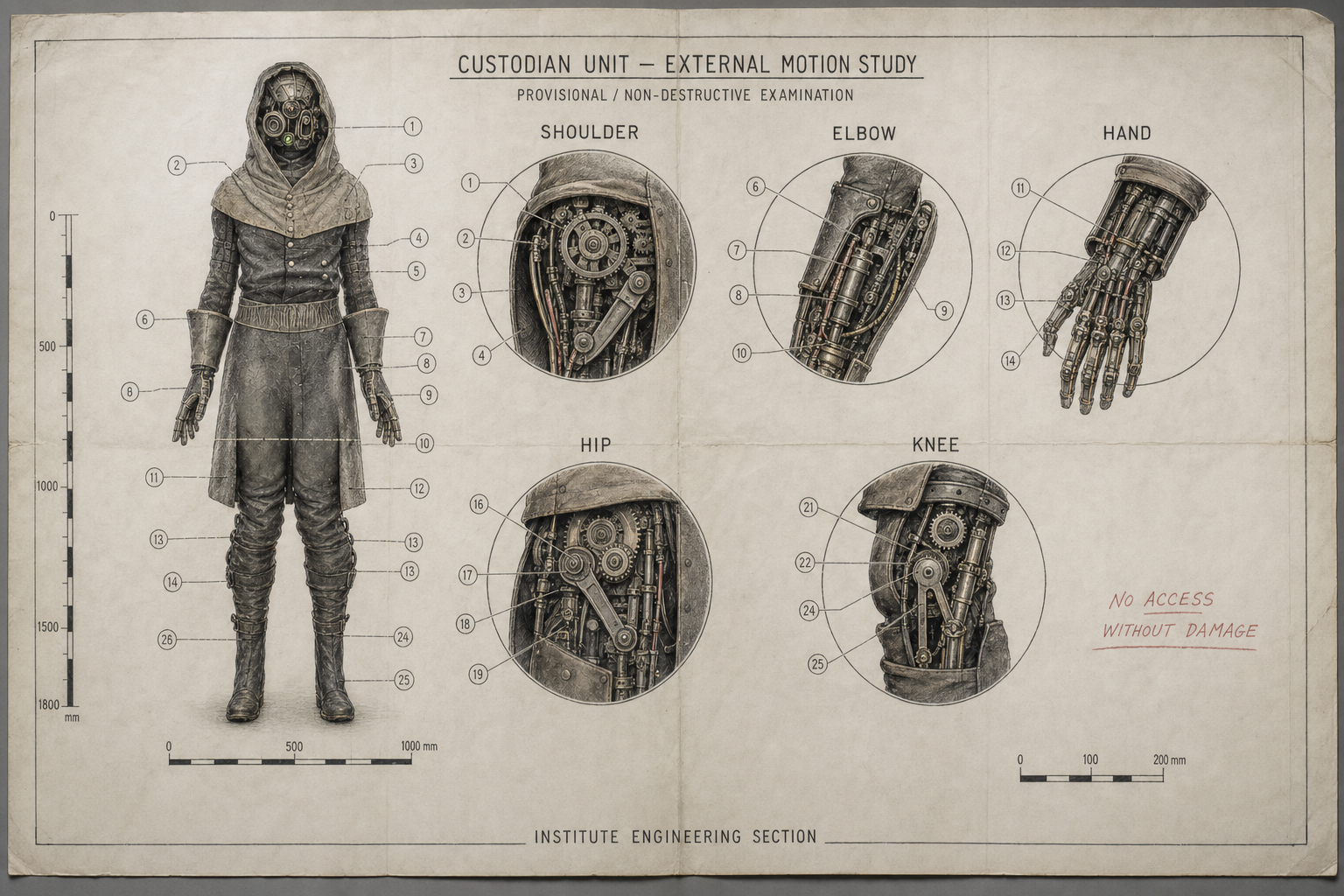
The recovered machine is approximately human in height and proportion. Its shape appears intentionally familiar: a narrow torso, two arms terminating in articulated hands, paired legs and a head positioned where an attendant's face would normally be expected. This may have been a practical concession to the hospital environment. A machine required to pass through wards, use doors and work beside conventional furniture benefits from human dimensions; a machine expected to approach distressed patients also benefits from not presenting itself as an exposed industrial mechanism.
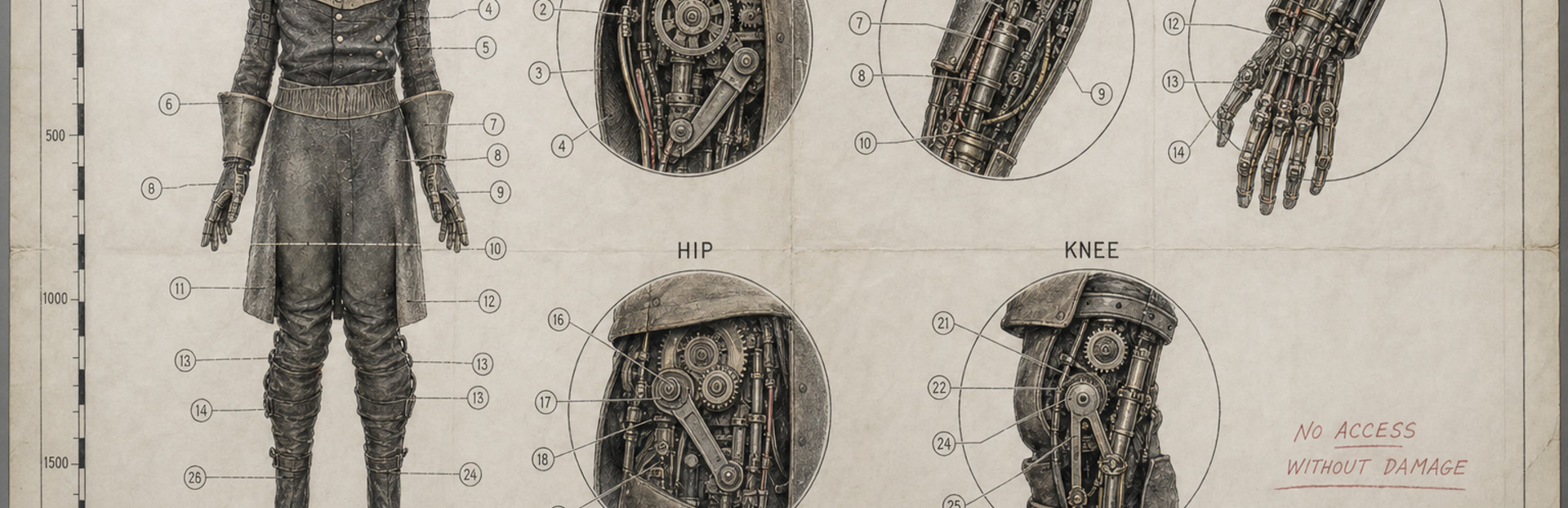
Malin's solution was concealment rather than imitation. Almost the entire frame is covered by toughened dark leather, layered panels and an unidentified woven webbing. A broad hood and shoulder cowl soften the outline of the head and neck. Braced cuffs conceal the wrists and lower forearms, while wrapped sections around the knees and lower legs prevent any direct view of the principal load-bearing joints. The covering is functional and heavily worn, but its arrangement gives the unit the distant appearance of a quiet hospital attendant rather than a walking machine.
The hands are the clearest exception below the neck. Their narrow jointed fingers are metal, with proportions close enough to a gloved human hand to suggest the handling of doors, trays, restraints or patient clothing. No attempt has yet been made to flex them. Surface examination found no obvious release catch and no safe point at which controlled force could be applied without risking damage to tendons or linkages concealed inside the wrist guards.
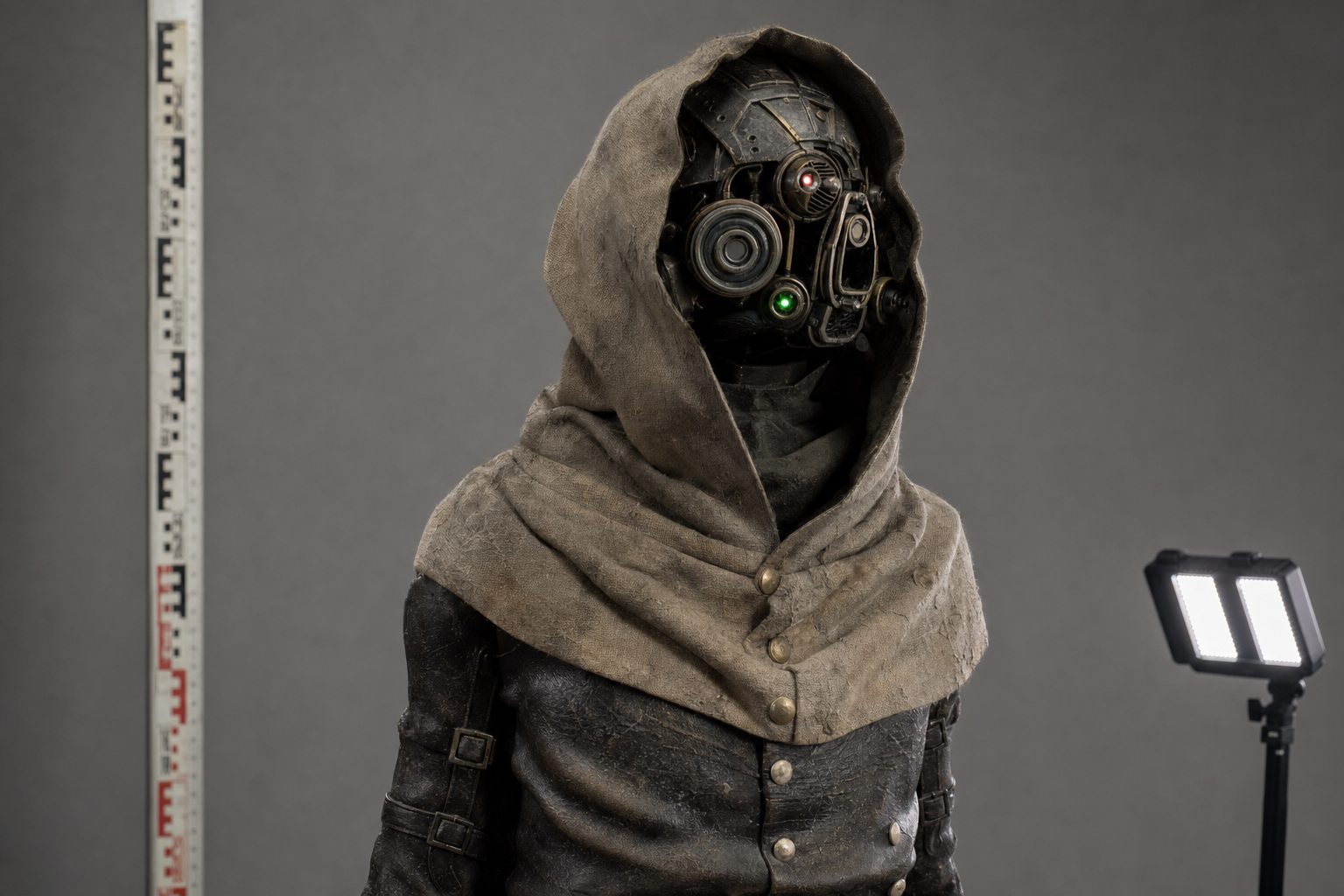
The head is the only area where the mechanical construction is openly visible. It contains a dense, asymmetric arrangement of circular receptors, grilles, shutters and small housings. The most cautious interpretation assigns these to visual detection, audio reception and speech reproduction. That reading is consistent with staff and patient records describing Custodians that could identify an approaching person, respond to spoken instructions and issue short verbal directions. It does not explain how those functions were coordinated.
Institute engineers have been unable to find a conventional service seam around the head assembly. Apparent fasteners do not release under safe torque, while several plates seem to interlock beneath the visible casing. Imaging has produced overlapping densities rather than a useful internal map. The present conclusion is uncomfortable but simple: the head may not be dismantled without destroying the very arrangement the examination is intended to understand.
This creates a considerable historical problem. The visible fittings resemble materials and manufacturing methods available in the late 1920s and early 1930s: blackened steel, brass, treated fabric, glass, leather and components resembling acoustic or optical instruments. The integration of those parts does not resemble any known autonomous bipedal system of the period. Modern walking machines emerging from Asian robotics laboratories provide a useful comparison for the difficulty of balance and coordinated motion, but not an explanation for how Malin achieved comparable functions with the engineering available to him.
The date itself is not in serious doubt. Custodian systems are mentioned repeatedly in patient complaints, nursing reports, maintenance requests and internal correspondence from before the closure of Asylum Rock in 1936. They appear again in the 1950s diaries of Anne Shepherd, who described encountering several units while exploring the islands. Her accounts were once treated as evidence of exhaustion, misidentification or later embellishment. The recovered body makes that dismissal considerably harder to maintain.
Shepherd also recorded finding portions of Troy Malin's development journals. According to her notes, Malin made frequent reference to ancient technologies which he believed could be adapted through his own engineering methods. Shepherd did not preserve enough of the original wording to establish what those technologies were, where Malin obtained them or whether the term ancient was literal. The journals themselves have not been recovered in a form the Institute can authenticate.
It is therefore possible that Malin was disguising conventional research behind grand language, borrowing from an earlier body of technical work, or attempting to describe principles for which he lacked a modern vocabulary. It is also possible that the research was connected with the event that closed the island in 1936. Documentation is presently too fragmentary to choose between those explanations, and the existence of an extraordinary machine should not be used to make every extraordinary claim about its creator true by association.
The most troubling observation occurred during removal. Once the front and upper packing material had been cleared, the Custodian was brought out of its crate with a lifting frame. When that support was reduced, the unit remained standing. It did not sag at the knees, settle against the frame or fall. After the lifting straps were removed completely, it continued to bear its own weight without visible correction.
It has remained in that position. There has been no step, turn, gesture or measurable change of posture. No speech has been recorded. The small points visible in the head assembly remain faintly luminous, but their function is unknown and their intensity has not varied in response to light, sound or movement. The distinction between inactive and unpowered is therefore important: the Custodian is inactive in the sense that it does not act, but the Institute cannot yet demonstrate that it is without power.
No battery compartment, fuel connection, wound spring access, pressure line or external cable has been found. A lead engineer has proposed that the machine may receive power without a physical connection, possibly from equipment housed on Pandora's Rock. The hypothesis is consistent with a small group of Malin papers concerning transmissible electrical power, but it remains speculation. Pandora's Rock cannot presently be approached safely enough to place instruments, interrupt a possible transmission path or test whether distance changes the condition of the unit.
Alternative explanations remain under review. The frame may incorporate a mechanical standing lock which engaged during packing; a long-duration spring or pressure accumulator may preserve only enough energy to hold the joints; or the visible posture may be maintained by a passive balance arrangement more sophisticated than external examination has revealed. The Institute's provisional joint study records several mechanisms that could have been constructed using period materials, but these are engineering models, not confirmed views of the Custodian's interior.
For the present, the machine has been transferred to a secure examination unit. Work is limited to photography, surface microscopy, passive imaging, environmental monitoring and measurements that do not require movement or disassembly. Every session is supervised by the Institute's head of security, with the room cleared before any change in lighting, sound or electrical equipment is introduced.
The caution is not an assertion that the Custodian is about to move. It reflects the opposite problem: no one yet understands why it does not fall. A complete machine has survived where only fragments were expected, in a basement that may have concealed an overlooked part of Malin's production system. It stands in silence, dressed to resemble a human attendant, while the Institute attempts to determine whether it is a dormant mechanism, a locked structure or something that is still waiting for an instruction.