Institute researchers trace Asylum Rock from its earliest Norse record and nineteenth-century surveys through Troy Malin's modular hospital, automated railway, nursing systems, and semi-autonomous wards.
This article consolidates the Institute's present historical account of Asylum Rock. It draws together Malin family papers, hospital planning material, engineering records, later field evidence, and the older songs and poems in which the island first enters the surviving record. Some parts of that history are well documented. Others survive only through copied verse, retrospective family catalogues, or technical papers written after the systems they describe had already changed.
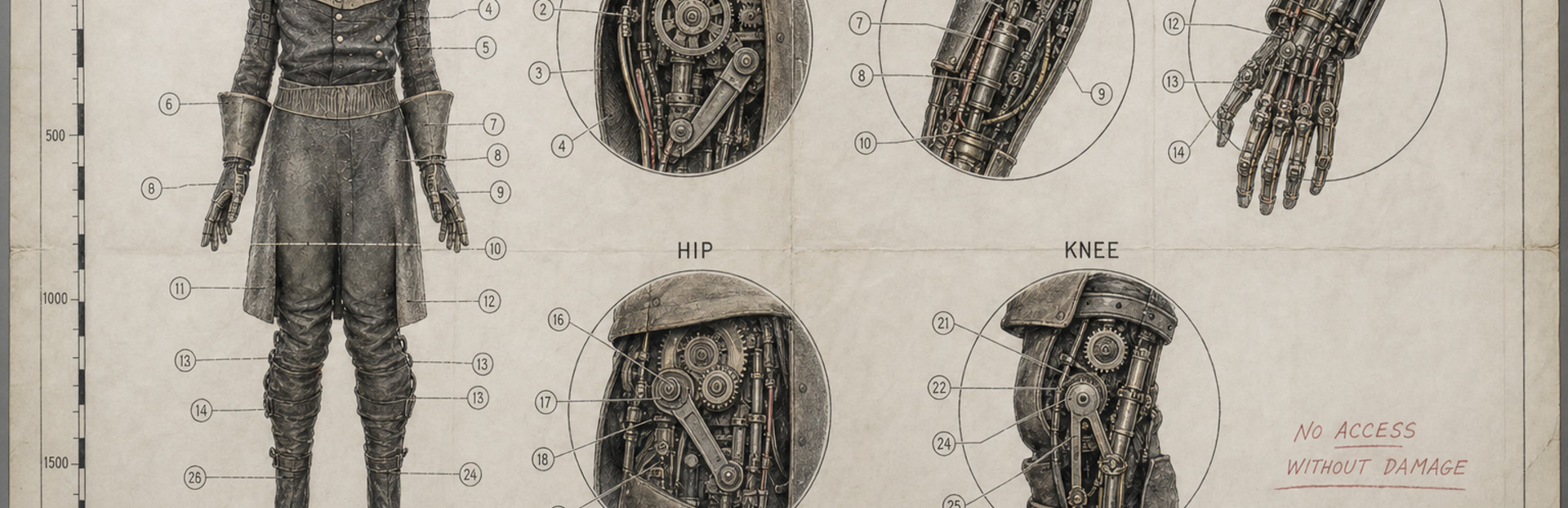
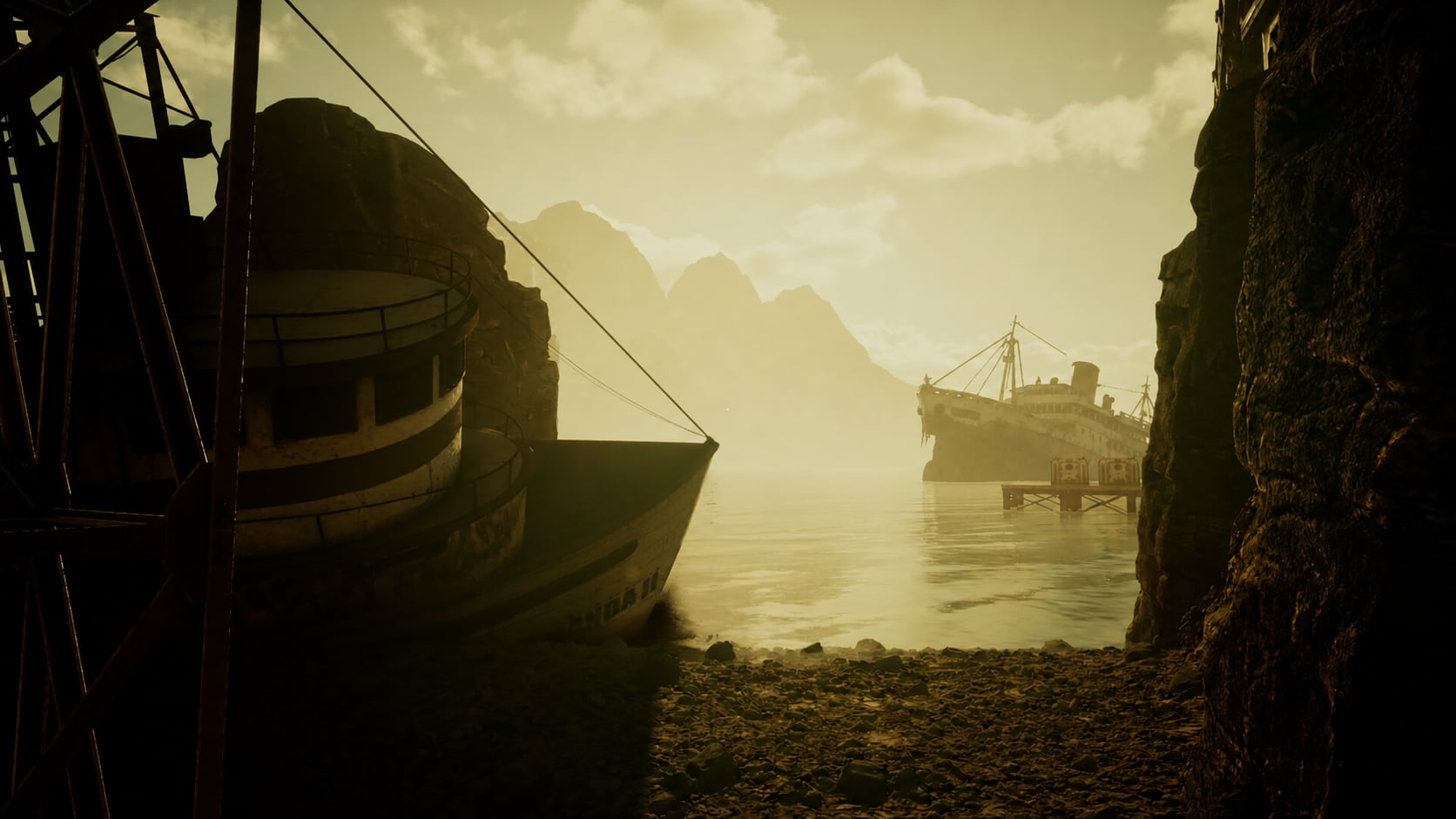
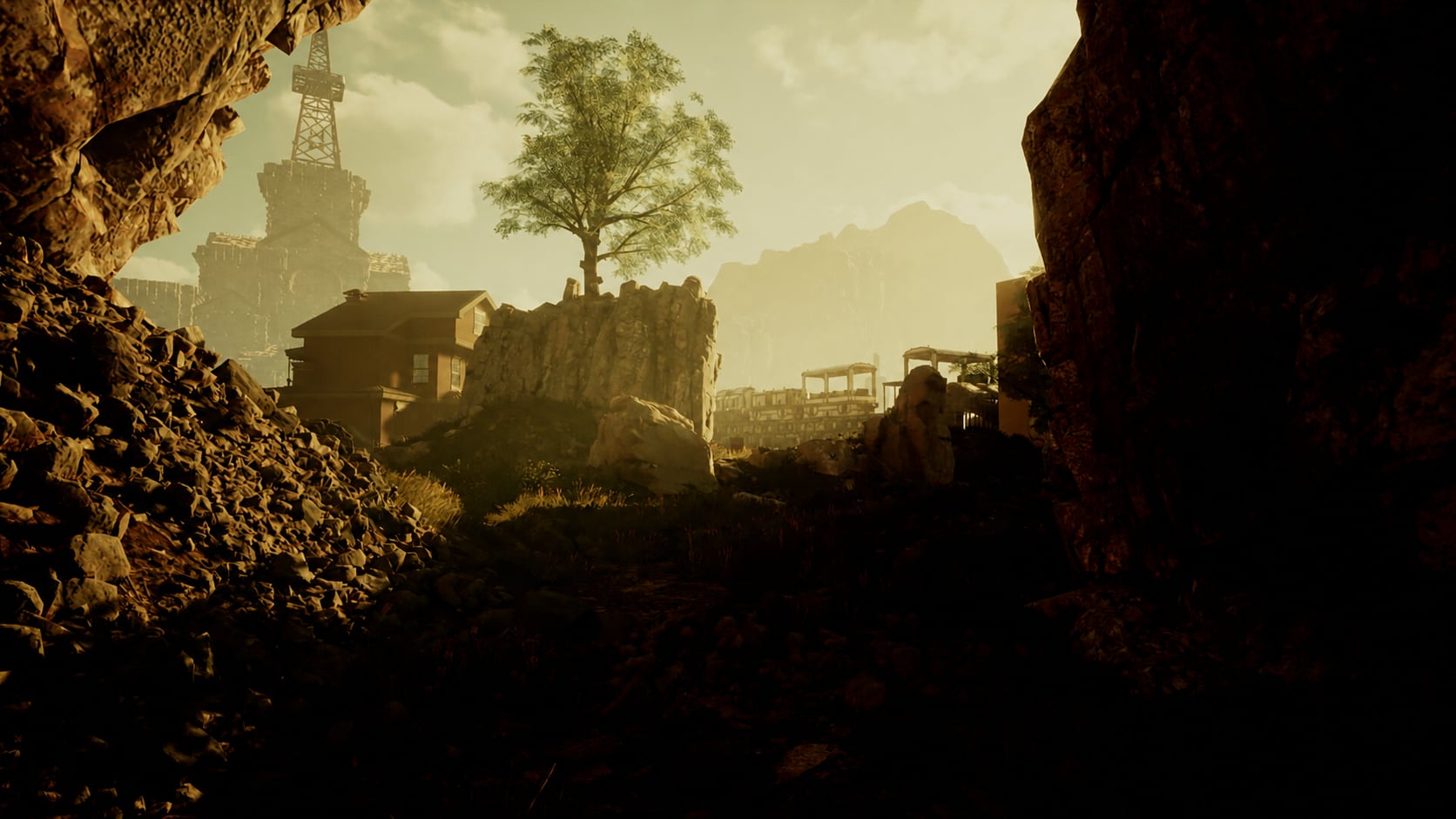
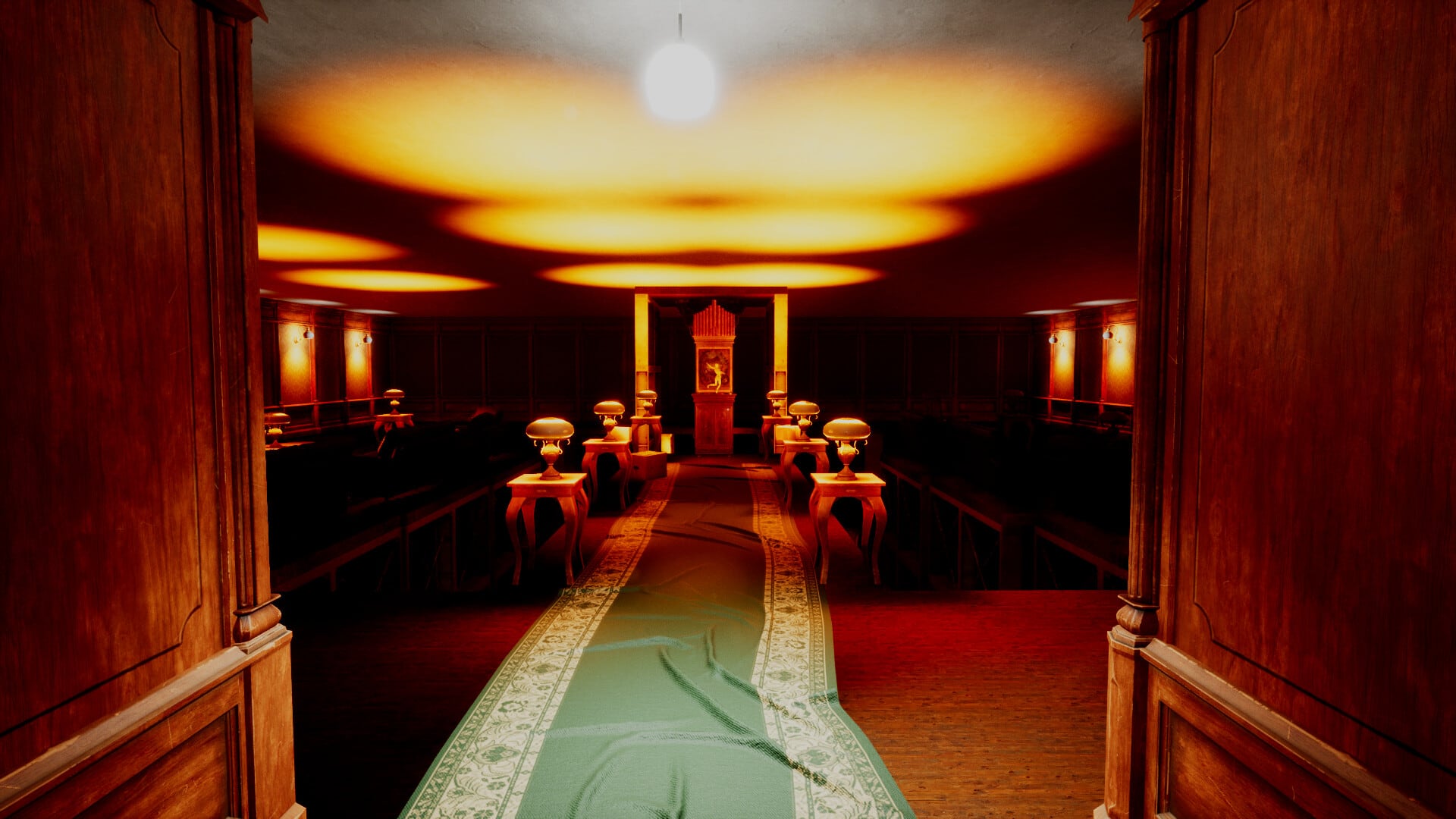
The distinction matters. The images published with this article are Institute visual and mechanical reconstructions intended to help readers understand scale, route, and design. They are not recovered historical photographs or surviving blueprints. The documentary links are instead provided by the connected records, particularly AR-HIS-0003, AR-ENG-0004, AR-ENG-0006, and AR-ENG-0001.
Taken together, those records describe something more complicated than the construction of a remote hospital. They describe Troy Malin's attempt to place a modern medical institution inside a structure whose builders, limits, and original purpose were unknown, then make that institution capable of adapting and operating with progressively fewer people.
Before the modern name
Both Asylum Rock and Pandora's Rock are modern names. The earlier name of Asylum Rock has not survived in any record the Institute can verify, and the earlier naming history of Pandora's Rock remains incomplete. The oldest material associated with Asylum Rock is not a map or deed but a group of songs and poems from the period in which Norse settlers controlled the surrounding islands.
Those compositions do not describe settlement within the great structure. They describe distance. Even in accounts otherwise concerned with conquest, difficult crossings, and the occupation of exposed land, the island's immense stone forms are treated as something to be watched and avoided. The record is literary rather than architectural, but its consistency is significant: the structure was already ancient when the Norse were present, and it was sufficiently imposing to shape how they spoke about the island without becoming a place they claimed to understand.
Later Malin family tradition asserted a line of stewardship reaching back into that Norse period. As the earlier site-selection record AR-HIS-0003 notes, the Institute cannot yet determine where legal history ends and family mythology begins. The songs establish an old awareness of the island. They do not establish a continuous Malin title, identify the builders, or recover the island's lost name.
Stone, structure, and the nineteenth-century surveys
By the nineteenth century, the island could be examined more systematically. Archaeologists and architects were permitted to explore parts of Asylum Rock while the first hospital works were being considered. Their measurements placed the highest of the visible structures at more than 200 metres, rising in severe vertical masses that dominated the approaches and remained visible across the neighbouring channels.
The surveyors' greater difficulty was not height but definition. In several places, dressed surfaces passed into fractured island stone without a clear foundation line. Elsewhere, passages appeared to follow natural faults before opening into spaces too regular to be comfortably described as caves. Walls, buttresses, shelves, and columns seemed to emerge from the same material as the rock around them. The effect was not simply that a building had been placed on an island, but that construction and island had been made continuous.
This uncertainty explains the cautious language in later estate plans. The older remains are recorded as monolithic structures, unidentified works, or existing spaces rather than as a single named building. No surviving nineteenth-century report identifies an architect, culture, or period of construction. Nor does any report establish that every visible mass belonged to one coherent design. What the surveys do establish is scale, antiquity, and an unusual physical relationship between built form and geology.
The Malin inheritance
At the death of their father, the family holdings were divided between the brothers. Troy Malin received Asylum Rock and the modest hospital operation then associated with it. Ulysses Malin inherited Pandora's Rock and became the last keeper identified in the Institute catalogue. This division did not separate the islands operationally. Estate correspondence continued to treat them as parts of one controlled route, with Gondola Island serving as the western approach.
The inherited medical provision was a precursor, not the institution later known as Asylum Rock Hospital. It occupied a simple building in the area subsequently absorbed into the cargo works. For that reason, the catalogue can accurately describe Troy both as an heir to an existing hospital concern and as founder of the vast hospital complex that followed. The organisation remembered under his name was created by his expansion, engineering, recruitment, and medical programme.
Troy appears to have regarded the cyclopean scale and strange interior geometry with less apprehension than earlier visitors. To him, the ancient spaces represented capacity already won from the island. Excavating conventional foundations across such difficult ground would have been costly and slow. Building within the existing volumes offered an alternative: modern rooms, wards, and treatment facilities could be inserted as modular structures without requiring the old shell to be fully understood.
A hospital inside the structure
The resulting hospital was therefore not planned as one fixed building. Malin proposed simple modular units that could be assembled inside the great chambers and linked to internal rail and service routes. Individual rooms could remain conventional in scale even when the enclosing space rose far beyond ordinary architecture. This allowed the institution to create very large hydrotherapy wings, treatment centres, and ward groups while retaining the ability to move or replace their component parts.
Railway design was central to the proposal. Troy's engineering experience allowed him to treat a ward not only as a place but as a unit within a transport system. Ward wings and service modules could be repositioned as demand changed. In its most ambitious form, the plan claimed that the hospital could configure itself around a single patient or restructure to accommodate a thousand, bringing the required wards, routes, and treatment functions into service while leaving unused areas isolated.
The surviving archive does not yet show that every planned configuration was achieved. It does show the same principle repeated across hospital systems: internal transport lines, patient routing, cargo yards, diagnostic suites, hydrotherapy reserves, greenhouse provision, tabulation rooms, and punched instruction stores. Each element could be defended as practical infrastructure. In combination, they made the hospital resemble a changing mechanical system housed inside an older and much larger one.
A medical project after the Great War
Troy's programme acquired particular urgency after the Great War. Servicemen returned with severe psychological injuries that were frequently misunderstood, unnamed, or treated as failures of discipline. Already known for medical and engineering work, Troy argued that a remote institution with purpose-built treatment space could offer therapies that were only beginning to receive serious attention on the mainland.
The hospital promoted modern treatment, including new approaches then in their infancy. Its hydrotherapy capacity was built on a scale that only the island's interior volumes and Malin's water engineering could support. The later desalination record AR-ENG-0001 shows how this ambition extended beneath the wards: linked systems were intended to process seawater, maintain reserves, and continue supplying treatment areas even when ordinary deliveries were disrupted.
Specialist doctors were recruited from around the world. Their presence helped establish the hospital's reputation and supported the range of treatment Troy wanted to offer. Yet the same remoteness that provided privacy and space made the institution difficult to operate. A visiting specialist could be housed for a defined period. Nurses, orderlies, cleaners, kitchen workers, porters, and maintenance staff required ordinary wages, permanent living space, dependable supply, and a willingness to remain on the islands. Those needs grew with every new ward.
The staffing problem becomes an engineering problem
The hospital's central practical question was therefore not whether Troy could build enough treatment space, but how he could staff it. Recruitment failed to keep pace with capacity. Bad weather could interrupt movement. Skilled personnel could be called elsewhere, while routine tasks continued every hour of every day. Malin responded in the manner visible throughout his work: he attempted to turn dependence on labour into a problem of mechanisms, routes, and repeatable instructions.
The first target was not diagnosis or therapy. It was the vast body of repetitive work surrounding patient care: carrying drinks, delivering meals, moving linen and supplies, presenting medication, conveying messages, checking routes, and alerting trained staff when direct intervention was required. The 1924 ward-service plans catalogued as ENG-WS-1 belong to this stage. They describe tray service, acoustic location, and linked operation rather than a replacement for medical judgement.
Automation expanded because those limited systems appeared useful. Central tabulation and relay apparatus could coordinate schedules and destinations. Mechanical carriers could follow routes. Ward-service machines could undertake regular rounds. With each task transferred, the number of people required to keep a department functioning could be reduced, and the hospital could continue expanding into parts of the structure where maintaining a permanent human staff would have been difficult.
From automata to Nurse and Custodian systems
Troy's early mechanical thinking was influenced by French automaton design popular in the Victorian period and by celebrated earlier machines, including the Mechanical Silver Swan of 1773. Such devices demonstrated that careful articulation, cams, wire systems, and concealed armatures could produce motion that appeared far more delicate and responsive than the bulk of the machinery suggested.
Malin's experiments pursued better articulation, smaller wire-driven pulley and armature systems, and tighter use of internal space. The purpose was not imitation for display. It was to give service machines sufficient reach and control to operate in furnished wards, carry objects, work near beds, and communicate without every action requiring a human operator. By the early 1930s, the record identifies Nurse and Custodian systems intended for more direct interaction with patients.
Claims for these systems must be separated by strength of evidence. Hospital papers describe rudimentary recorded phrases and later machine-generated speech. Patient and staff reports connected with the Custodian record describe short verbal directions, while recovered apparatus appears consistent with visual, acoustic, and speech functions. The complete Custodian catalogued in AR-ENG-0006 has not produced an audible response under present non-destructive examination, so the surviving unit cannot by itself verify the full historical claim.
The BOB Maniple and routine autonomy
The BOB Orderly was the most extensive expression of routine labour substitution. The earliest accounts describe a large wheeled service machine carrying drinks, food, and trays between kitchens and wards. Later reports add recorded speech, autonomous route correction, and patrol duty near stairwells, thresholds, and service corridors. The development is examined in detail in AR-ENG-0004.
BOB units were not necessarily sophisticated in isolation. Their importance lay in scale and coordination. Groups of six, described as a Bob Maniple, may have shared limited priorities for movement, warning, and patient recovery. More than one hundred units could plausibly have operated across the hospital, with later variants associated with spotting, restraint, and gathering. The archive remains cautious about the results, particularly where Malin documents use the reassuring term non-lethal without establishing that restraint was harmless.
Alongside Nurse and Custodian systems, the BOB network allowed ordinary activity to continue without constant human direction. Drinks could move, routes could be watched, patients could be addressed, and staff could be summoned by machines. Contemporary and retrospective records consequently suggest that some departments could function for days at a time without direct human intervention. This was semi-autonomy, not independence: treatment policy, repair, specialist medicine, and institutional authority still depended on people, even when the visible ward routine did not.
Replacing the gondola
The old gondola lift had made the island route possible, but it was slow, weather-exposed, and increasingly inadequate for the movement of patients, staff, supplies, and modular equipment. Troy replaced it with an automated monorail running from Gondola Island to Asylum Rock and onward to Pandora's Rock. The new route joined the family holdings as an operating system rather than a sequence of separate crossings.
Automation mattered as much as speed. A railway that did not require a full crew for every movement could serve scheduled hospital traffic, carry cargo through controlled stages, and connect with the internal track logic of the wards. Gondola Island remained the approach and service point. Asylum Rock became both destination and interchange. Pandora's Rock remained the more restricted end of the line under Ulysses Malin's stewardship.
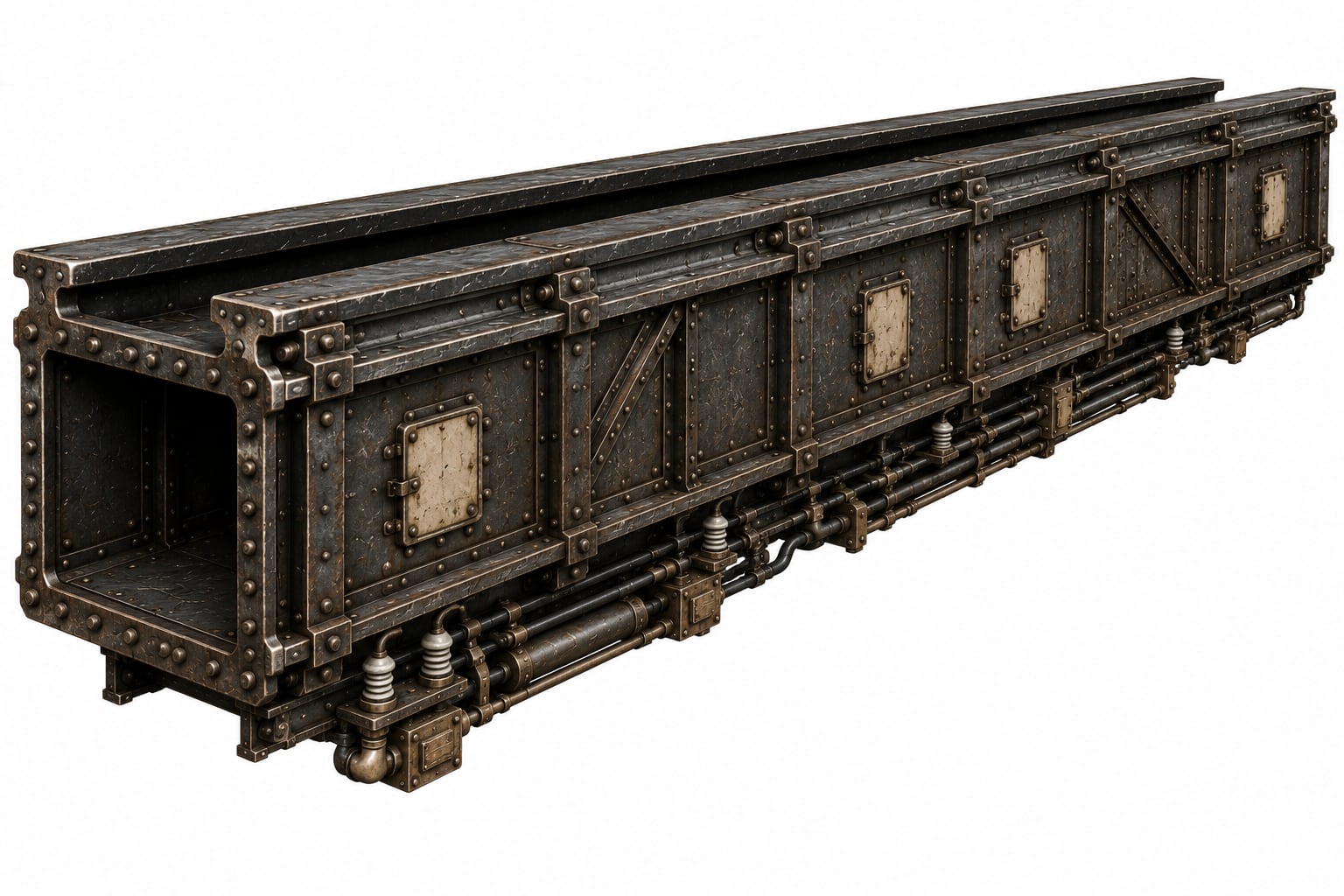
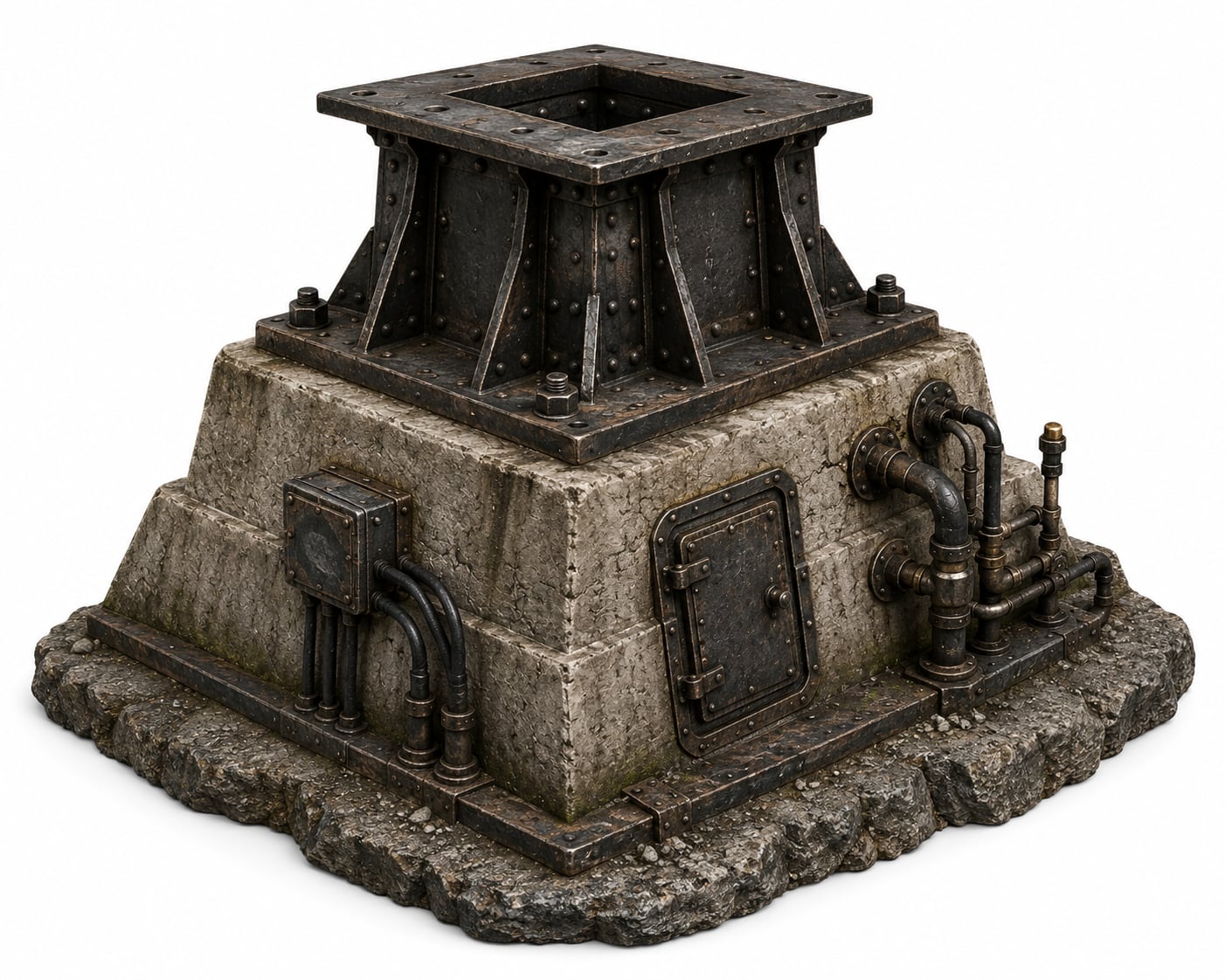
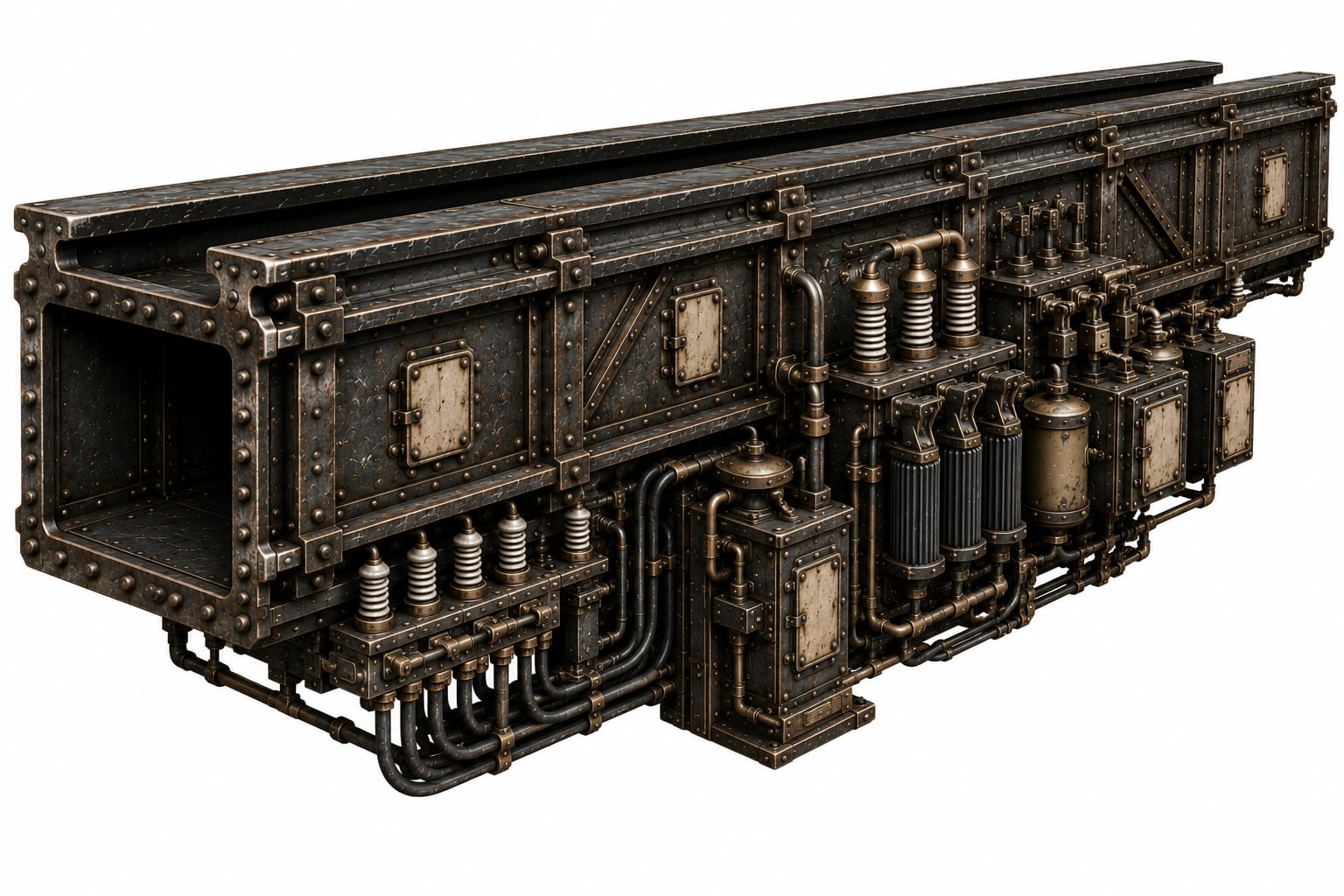
The mechanical plates released with this article are modern Institute reconstructions. They illustrate a possible riveted carriage, service base, and machinery arrangement consistent with the scale and industrial language of the route. They do not establish exact alignment, power source, dimensions, station architecture, or surviving equipment. The route itself belongs to the consolidated Malin record; the plates are aids to interpretation, not independent proof.
A reconfigurable institution
By the early 1930s, the hospital had become an institution whose architecture, logistics, and patient care were inseparable. Modular wards could be placed within ancient chambers. Rail systems could bring the active parts of the hospital into useful relation. Water, cargo, food production, schedules, and ward service were designed to remain available despite isolation. Nurse, BOB, and Custodian systems reduced the number of people needed to keep those parts moving.
This helps explain why later witnesses could encounter active machinery after ordinary administration had failed. Anne Shepherd's 1958 account, AR-SHEP-0002, describes BOB Orderlies still recognising, directing, and organising around a patient decades after the first ward-service plans. The so-called Malin Failsafes may have preserved power and instruction in sealed sections, but their limits and present condition remain under investigation.
Troy's achievement was therefore not merely to occupy the old structure. He devised a hospital that could alter its own working arrangement inside it. The same flexibility that answered fluctuating patient numbers also made the full institution difficult to map, close, or understand. A ward absent from one route plan might not have been demolished; it might simply have been moved, disconnected, or left beyond a sealed transport line.
What the history does not yet answer
No surviving record identifies the builders of Asylum Rock's ancient structures or explains why architecture and geology merge so closely. The Institute has not recovered the island's original name, established the complete Norse textual chain, or determined how much of the nineteenth-century survey archive remains in private hands. The dimensions of inaccessible interior spaces also remain estimates rather than a complete measured plan.
The hospital record is fuller, but important gaps remain. We do not yet know which reconfiguration schemes operated exactly as Troy intended, how frequently entire wards were moved, how the automated monorail was controlled, or which departments achieved sustained semi-autonomous operation. The status of machinery within sealed levels is likewise unresolved.
What can now be stated with confidence is that the history of Asylum Rock did not begin with the hospital, and the hospital cannot be understood as an ordinary building placed on a remote island. Troy Malin inherited a site already defined by ancient scale, uncertain boundaries, and a controlled family route. He used those conditions to create an institution whose wards, transport, utilities, and mechanical attendants could change with demand. The older structure made his project possible. His project, in turn, made the older structure harder to separate from the machine still being investigated today.